

 Blustream AV distribution
Dedicated home cinema rooms remain our favourite brief, and there is still no better way to watch a film. From a fully treated cinema room with motorised screen and tiered seating, to a sharp media room that doubles as a snug, we design and install systems that look good, sound right and stay easy to use.
WHAT WE DELIVER
Honest, hands-on, and built to last.

Picture, properly tuned
4K and 8K projectors or large-format displays, calibrated for the room so dark scenes stay dark and bright scenes do not fatigue.

Sound that fits the space
Dolby Atmos and proper acoustic treatment where it matters, with discreet in-wall speakers if the cinema needs to disappear when off.

One remote control
Blustream matrix distribution carrying picture and sound, with Elan via Nice tying screen, lights and blinds so one button starts the film and resets the room afterwards.

Designed around the architecture
We work with the architect or builder so cabling, seating tiers and ventilation are all planned before the plaster goes up.
Dedicated cinema or media room? The honest difference
The first question on every home cinema brief is whether you want a dedicated room or a media room. They are not the same thing, and the right answer depends on how you actually want to use the space.
A dedicated cinema is a room set up for one thing: watching films, properly. That usually means a projector and a large screen, acoustic treatment on the walls, tiered seating if the room is long enough, and lighting that goes from "comfortable to walk in" to "completely dark" in a single button. It is the right brief if you have the space, you watch a lot of films, and you want the experience to feel different from the rest of the house.
A media room is a multi-purpose space. Cinema is one of the things it does, but it might also be where the kids play games, where the family watches sport on a Saturday, where someone reads on a Sunday afternoon. It usually has a large flat-screen rather than a projector, comfortable seating that does not have to face one direction, and lighting that supports more than one mood.
If you cannot decide, we ask one question: when the room is not being used for films, what do you want it to be? The answer tells us which brief to design for.
Designing for Dolby Atmos and great sound
Atmos is a marketing word that has come to mean "good cinema sound". In practice, getting it right is part speaker layout, part acoustic treatment, and part calibration.
The speaker layout matters because Atmos uses overhead and side channels to put sound in a position rather than just in a direction. We design speaker positions around how the room is actually used, not around a generic 7.1.4 diagram. In real Edinburgh rooms with sloping ceilings and original cornicing, that takes thought.
Acoustic treatment is the unglamorous half of the job. Hard walls and bare floors reflect sound until dialogue stops being clear. Soft furnishings, fabric panels and bass traps absorb the right parts of the spectrum. Done well, you do not notice it. Done badly, every film sounds like it is being shouted at you in a school gym.
Finally, calibration. Every cinema we install gets time-aligned and level-matched after the kit is fitted. We use measurement microphones, not opinions. The result is dialogue that you do not have to lean forward for, and explosions that sit where the director wanted them to sit.
Picture: projector, screen and display choices
For dedicated cinemas, projection is almost always the right call. Modern 4K projectors deliver a picture at sizes a flat-screen simply cannot match, and once you have committed to a dark room you have the conditions a projector needs to look its best. We specify the projector and the screen as a pair, because the wrong combination of brightness, gain and throw distance will spoil even excellent kit.
For media rooms we usually recommend a large-format OLED or QD-OLED display. They keep their picture quality in mixed light, switch on instantly, and live happily in rooms that are not designed primarily for film. An 83-inch OLED in a smart media room is often a more honest answer to the brief than a projector pretending it is dark when the curtains are half open.
Either way, we calibrate the picture during commissioning. Out of the box settings are tuned for shop floors, not for living rooms.
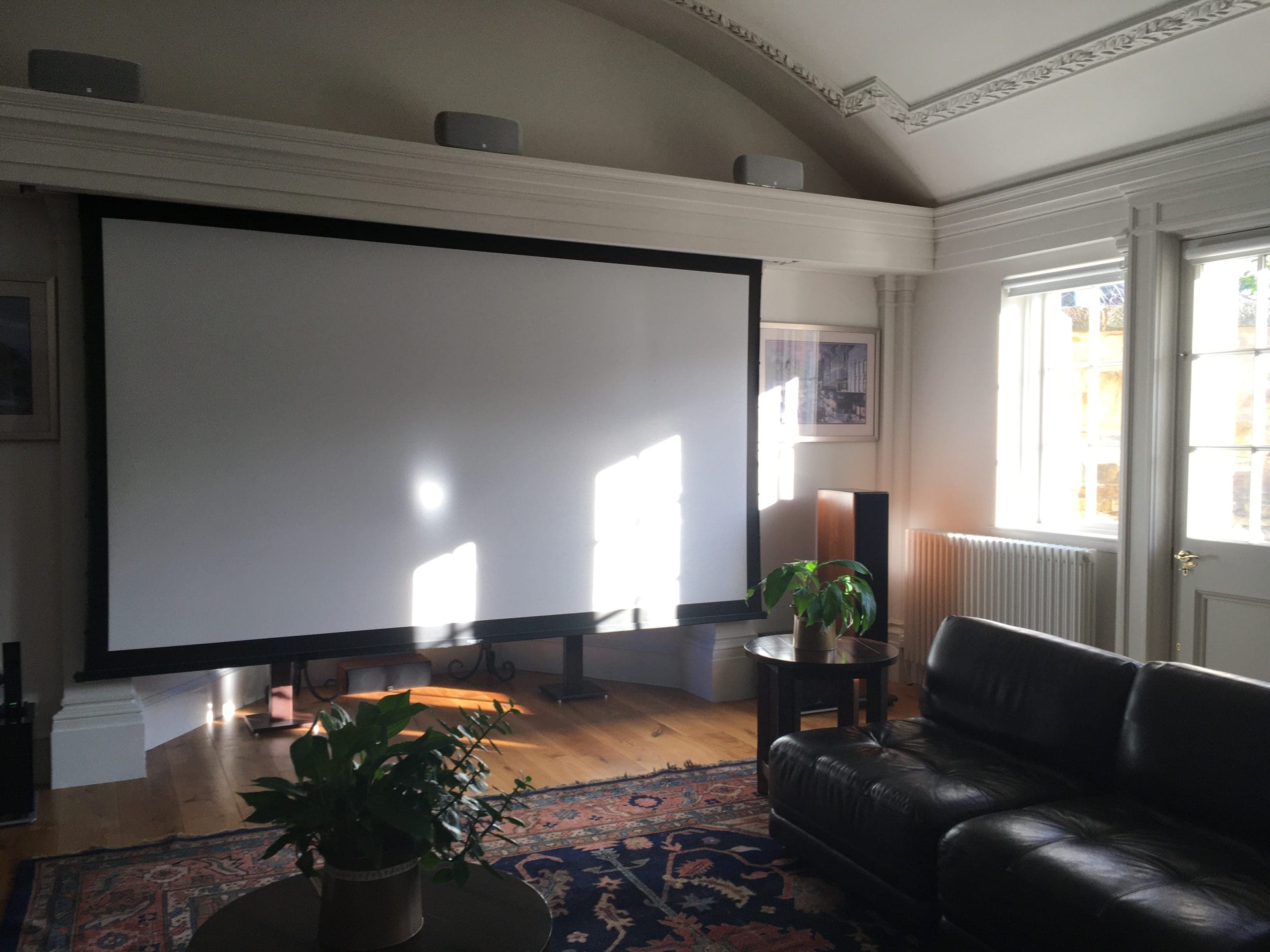
One remote: lights, blinds, sound and picture together
The promise of a cinema room is that one button starts the film and resets the room afterwards. Hubbub builds every cinema around Blustream AV distribution and Elan via Nice so that promise is real, not optional.
"Film night" is a scene. Lights down to twenty percent for thirty seconds, then off. Blinds lower. Screen drops. Projector wakes up and switches to the right input. Sound system powers on, in the right mode. Two minutes after the credits, lights come up to forty percent, blinds rise if it is daylight, and the system goes to sleep.
That is not magic and it is not expensive. It is design and a one-time setup. We agree the scenes with you during handover and tune them in the first follow-up two weeks later, once you have lived with the room for a bit.
Working with architects, builders and listed properties
The best cinemas are designed before the plaster goes up. First-fix cabling, ventilation routes, seating tier depths, the rack location and the screen wall structure all need to be agreed before the room is closed. We work alongside architects and main contractors on new builds and major renovations across Edinburgh and the Lothians, so that the cinema is part of the plan rather than retrofitted into a compromise.
In listed and period properties the constraints are sharper. We have built cinemas in Georgian townhouses where every cable route had to be agreed with the conservation officer, and where the screen and projector had to be reversible. It can be done, but it needs more thought and more lead time than the same brief in a modern home.
The featured Papple Steading project on our homepage is a good example of what is possible when the technology is planned with the build, not after it.
Frequently asked questions
How long does a home cinema installation take?
A retrofit media room usually takes between one and three weeks on site after design sign-off. A dedicated cinema in a new build runs alongside the construction programme, so the total elapsed time depends on the build, not on us.
Do you handle the building work too?
We work closely with builders and architects, but we do not normally take on the structural work ourselves. We provide the schedule of services they need from us at every stage of the build.
Can you retrofit a cinema into an existing room?
Yes. Many of our best cinemas are conversions of a study, snug or under-used reception room. We will tell you honestly if the room is wrong for the brief before we quote.
Is Dolby Atmos worth it in smaller rooms?
Often yes. Atmos done well in a smaller room can be more immersive than a poorly executed 7.1 setup in a larger one. The speakers, layout and treatment matter more than the headline format.
Do you support the system after handover?
Yes. Every install includes a follow-up visit, ongoing remote support and a maintenance plan if you want one.
Thinking of adding smart home technology? Book a consultation to discuss your project.
A 20 minute, no-obligation consultation. We will give you our honest view on what fits your home.