

 Ubiquiti, Araknis and Zyxel networks
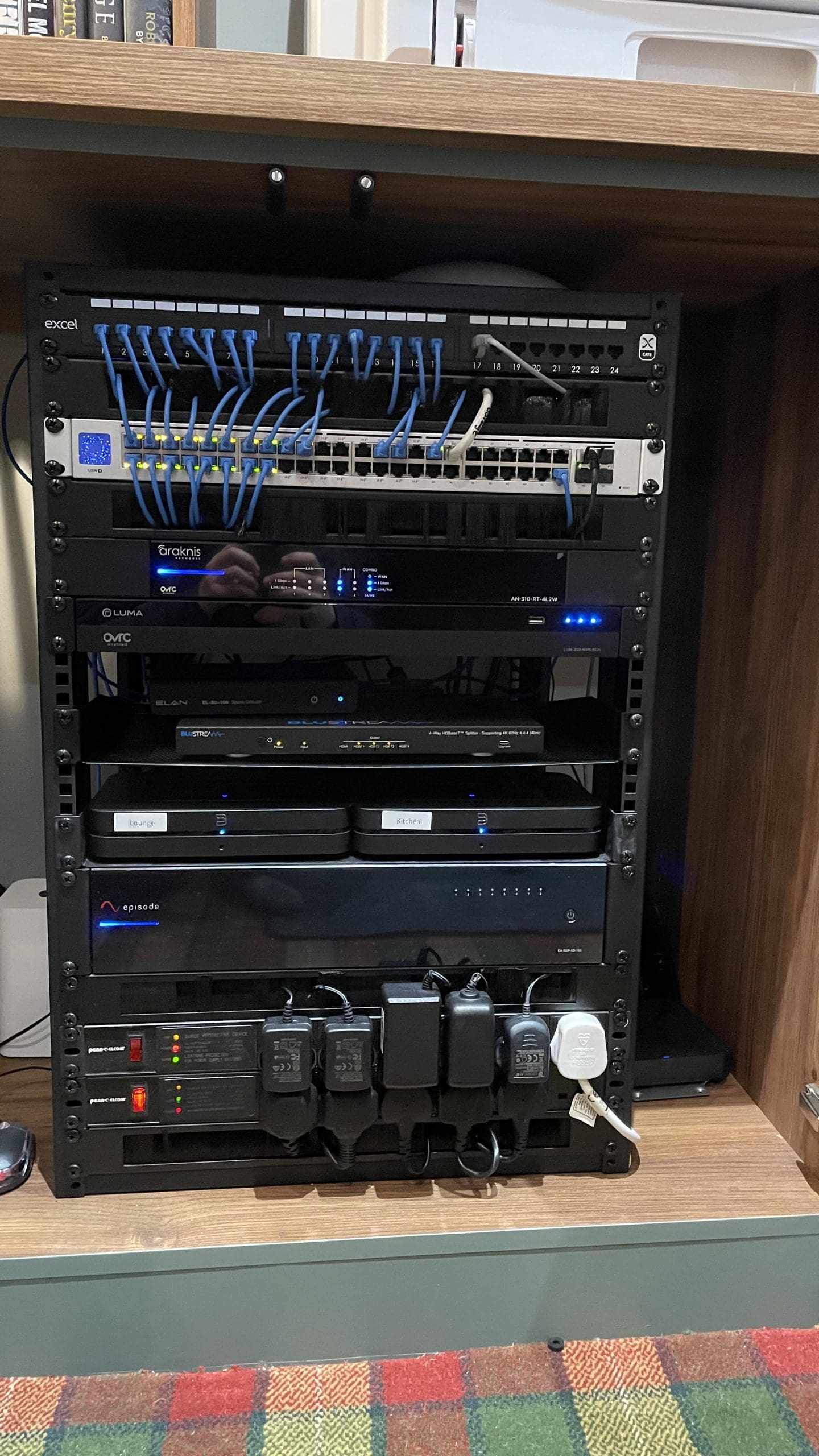
Behind every good smart home is a serious network. Without it, the Wi-Fi suffers, the cameras stutter, the audio drops and the lighting hesitates. We design and install enterprise-grade networking from Ubiquiti, Araknis and TP-Link with Zyxel firewalls, paired with Elan via Nice, Rako and Lutron RA3 so a single interface drives the whole property and grows with it.
WHAT WE DELIVER
Honest, hands-on, and built to last.

Designed once, expanded later
We engineer the network for the home you have plus the kit you will add, so the rack and the cabling stay sensible for years.

Elan, Rako, Lutron RA3
A single interface drives lights, audio, climate, cameras and entry. We program the system around your routines, not a generic template.

Proper segregation
Guest, family, IoT and business traffic kept apart with VLANs, so a compromised gadget cannot reach your laptops or your CCTV.

Visible to us, invisible to you
We monitor the systems we install.* Most issues we spot and fix before you notice; the rest get triaged the same day.*
*Available to clients on an active Hubbub maintenance contract.
The network behind the smart home
The smart home is only as good as the network it runs on. People do not usually think about it that way until something goes wrong, because the network is invisible by design.
Most domestic problems with smart kit are not the kit itself. They are the network. A poor router that loses devices under load. A switch that drops one camera every few hours. A Wi-Fi mesh that drops the lighting bridge when the kids open Netflix. We see this every week.
Hubbub builds the network first and the smart home on top. That is the difference between systems that age well and systems that get a reputation for being "a bit temperamental".
Choosing a control system
We work with three control platforms as standard: Elan via Nice, Rako, and Lutron RA3. Each one suits a different brief.
Elan via Nice (ELAN OS 9) is our default for whole-home control. One interface drives lighting, audio, cinema, climate, CCTV, access and shades. The touch panels are clean, the programming is flexible, and the platform integrates cleanly with the hardware we already trust. It is the right call where lots of subsystems need to behave as one.
Rako is our headline lighting platform and Hubbub is an authorised Rako installer. Keypads, drivers and bridges all from one ecosystem, with scene-level control across lights and motorised blinds. Rako pairs cleanly with Nice for whole-home control, integrates with Alexa or Nice Voice for voice command, and stays sympathetic to period plate work where the brief calls for it.
Lutron RA3 is supported where the brief specifically calls for it, particularly retrofit briefs in occupied homes where wireless keypads earn their keep. We deploy Lutron RA3 where it fits rather than as a default.
We do not pick the most expensive system out of habit. We pick the one that suits the brief and that will be supportable in ten years.
Designing a network you will not outgrow
A network designed for the home you have today will be tight in three years. Devices multiply. Bandwidth-hungry kit arrives. Working-from-home expectations rise. We plan for headroom.
For most family homes that means a managed core switch, dedicated cabling to access points, 10Gb capable copper on the runs that might want it, and a rack with room to grow. For larger homes and commercial sites, fibre on the backbone runs and PoE switching for the access layer is the default.
Power and resilience matter too. The rack gets a UPS sized for at least a graceful shutdown of the recording and access kit. Important kit is on dedicated circuits. We document it all so the next trade in the cupboard knows what they are looking at.
Cyber security sits inside the design, not bolted on at the end. Our networks pair managed firewalls and intrusion detection from Zyxel with switching and Wi-Fi from UniFi and Araknis, and VLAN segregation across the lot. Family, IoT, work and guest traffic each live on their own lane, with firmware kept current and traffic patterns reviewed on every visit. Cyber security upgrades come naturally as part of the maintenance cycle, not as an emergency call after something has gone wrong.
Networks in listed buildings and tenement flats
The smart home conversation in Edinburgh nearly always starts with the building. A network in a new build estate is one job. A network in a Category A listed Georgian on the World Heritage side of the New Town, with sandstone party walls, lath and plaster ceilings, and a conservation officer in the loop, is a very different job. We design for the second one as standard, and the first one becomes the easy job.
Period buildings change three things about a network. Where the cables can run. Where the access points can sit. And how the rack and patching get hidden. We walk the property before we quote, we agree the visible kit positions with you, and we agree the cable routes with the architect or the conservation officer if the consent regime requires it. Listed building consent is rarely the blocker people fear when the routes are sensible from the start.
Tenement flats bring their own constraints. Party walls cannot be drilled. The communal stair is not yours to chase. Floor cavities are shared with the flat below. We design around what is yours: service voids, redundant chimney runs, the back of skirting, the inside of fitted cupboards. The network ends up tighter and better-placed, not worse, because it has to earn its routes.
We have wired Georgian townhouses, Victorian villas, Edwardian terraces, working steadings, mews conversions and new builds in the same calendar quarter. The brief changes with the building. The standards do not.
VLAN segregation done plainly
Most homes mix every device on one network: laptops, phones, the family iPad, the smart fridge, the CCTV recorder, the lighting bridge, the doorbell. That works until something goes wrong, and then it fails in ways that are hard to diagnose.
VLAN segregation puts those devices into virtual lanes. Family on one lane. Guests on a separate captive portal. IoT and smart home kit on its own lane. Work and business on another. The internet still works for everyone. Devices on different lanes cannot reach each other unless we deliberately allow it.
This is invisible in daily use, and it is the single biggest reliability and security upgrade we put into every install.
Monitored and supported
We do not install a system and walk away. The networks and control systems we install report back to us. We see when an access point loses sync, when a camera goes offline, when the broadband drops. Most issues we fix before you notice.*
For things we cannot fix remotely, we offer same-day attendance under our support plans.* Quarterly health checks keep the system clean, patched and up to date. The relationship is ongoing, not transactional.
*Available to clients on an active Hubbub maintenance contract.
Frequently asked questions
Do I need a server cupboard?
Most homes do. It does not have to be large. A well-ventilated cupboard or a cabinet under the stairs is usually enough. Larger homes may want a dedicated AV room.
What if my broadband is slow?
A great network cannot make slow broadband fast, but it can stop the broadband being the bottleneck for the rest of your kit. We help with broadband provider choice and dual-connection failover where it matters.
Can the network be expanded later?
Yes. We design with capacity headroom. Adding an access point, a camera, a smart zone is a planned job, not an emergency one.
Will guests have decent Wi-Fi?
Yes. Guests sit on their own VLAN with bandwidth set sensibly. They get the same speed your family does, separated from your main systems.
Can you take over a system someone else installed?
Often yes. We assess what is there, recommend what to keep and what to replace, and take on ongoing support.
Can you install an Elan or Rako system in a listed building?
Yes. We do it regularly. Cable routes follow service voids and existing chases, in-wall keypads use heritage-friendly plate options where available, and any visible kit position gets agreed with you and with the conservation officer before we quote. Listed consent on a sensible plan is usually straightforward.
Thinking of adding smart home technology? Book a consultation to discuss your project.
A 20 minute, no-obligation consultation. We will give you our honest view on what fits your home.